
Generative Engine Optimization (GEO)
AI Visibility by Language & Country: Why There's No Global GEO (2026)
Short answer: AI citations vary dramatically by language and country, and for informational questions the language of the query matters more than the user's geography — though that flips for local-intent searches, and the evidence behind it can't fully separate the two. Models localize very differently, and the Chinese ecosystem is a separate world. For multi-market brands, there is no single "AI visibility" — measurement and strategy must be language- and geo-aware. This is part of our Citation Economy field guide.
Language beats geography
Profound's analysis of 3.25 billion citations across 7 models and 14 countries found that a country's geography is secondary to a more powerful force: the language of the query — and that the effect varies by model. Ask the same question in Dutch vs. English and you get a different source set, often more than you'd get by changing countries.
One honest caveat: Profound's study paired each country with its native language, so this is a strong directional signal — not a controlled experiment. Nobody has yet published a test that varies the user's location and the query's language independently. Treat "language beats geography" as the right default, not a law of physics.
Where geography still bites
Language wins for informational questions — but flip to local intent and geography takes over. Yext's study of 6.8 million citations found that Google, OpenAI and Perplexity all confirm using the consumer's location for questions about businesses and services: the same question asked from two places gets different answers, built from different sources (the same retail chains' own sites earned 70% of citations in rural markets vs. 20% in competitive urban ones). Meanwhile an independent 20-region test by dopest.io — one English prompt, 200 runs, language held constant — found the same handful of sources cited everywhere on Earth (one engine and one question, so directional rather than settled) — for generic questions, geography is noise. The lesson: if your buyers ask "best X near me," location is first-order; if they ask "best X," language is.
Models localize very differently
Temso AI's study of 7 million citations across six non-English languages and 12 countries found a 34-percentage-point gap between the most and least localized engines:
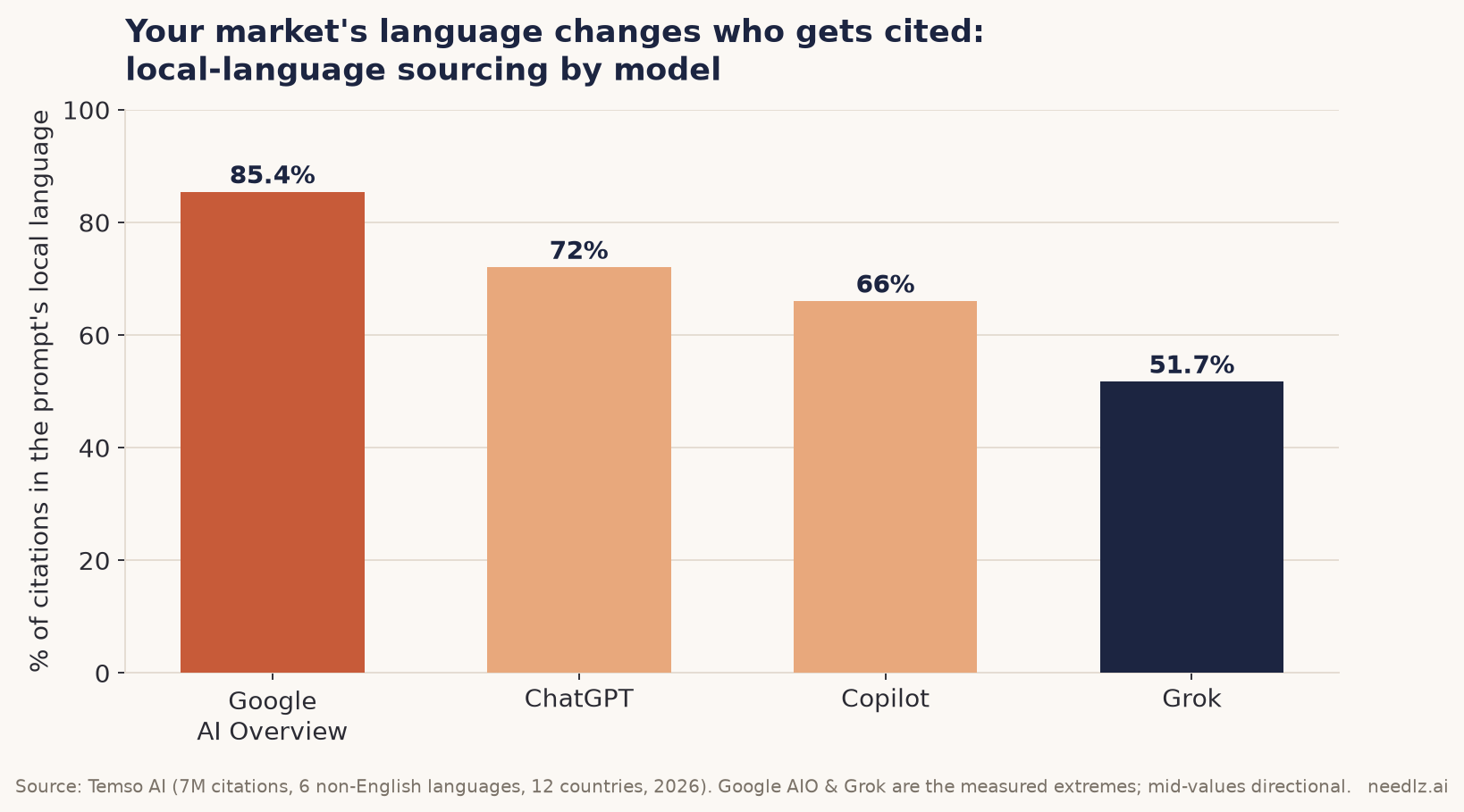
- Google AI Overview: ~85.4% of citations in the prompt's local language — the most localized.
- Grok: ~51.7% — the least; far more likely to answer a non-English query with English sources.
The practical effect: if your buyers ask in German, French or Spanish, Google's AI is far more likely to cite local-language content than Grok is. Your content and corroboration need to exist in the market's language, not just translated as an afterthought.
The East is a separate ecosystem
Chinese engines — DeepSeek, Qwen (Alibaba), Baidu ERNIE, Doubao (ByteDance), Kimi — draw on a distinct, largely walled-off source ecosystem of Chinese-language platforms. Western-web tactics don't transfer. A brand serious about China needs a dedicated Chinese-language GEO approach, not a global average.
What international brands must do
- Measure per language and per country, per engine — never a single global score.
- Build local-language content and corroboration in each priority market (especially for Google AI, which rewards it heavily).
- Pick engines per market — the leading assistant differs by country, and so does its source behavior.
- Treat China (and other walled ecosystems) as separate programs.
The opinionated bit
"Global AI visibility" is a comforting illusion. The reality is a patchwork of language-and-engine markets, each with its own citation logic. Brands that measure the patchwork — instead of a global average — will quietly win markets their competitors don't even realize they're invisible in.
For the full data and methodology, read The Citation Economy · related: Which Sources Does AI Cite?.
needlz.ai helps brands earn citations in AI answers — and proves the lift. Earned, never rented.