
Generative Engine Optimization (GEO)
Which LLMs Do People Actually Ask? (Consumer vs. Builder, 2026)
Short answer: There are dozens of large language models, but buyers only ask a handful — ChatGPT, Google Gemini, Microsoft Copilot, Meta AI, Perplexity and Grok. The many cheaper models you hear about (especially Chinese ones like DeepSeek and Qwen) are mostly what developers build products on, not where consumers ask questions. For getting your brand cited where customers actually look, only the consumer assistants matter. This is part of our Citation Economy field guide.
⏱️ Fast-moving data. Assistant market share is shifting monthly (Gemini's surge, Meta AI's billion users) — the shares below are point-in-time and may already have moved by the time you read this. Sources and dates are noted so you can re-check.
Where people actually ask
Consumer usage is highly concentrated. A handful of assistants own nearly all of it:
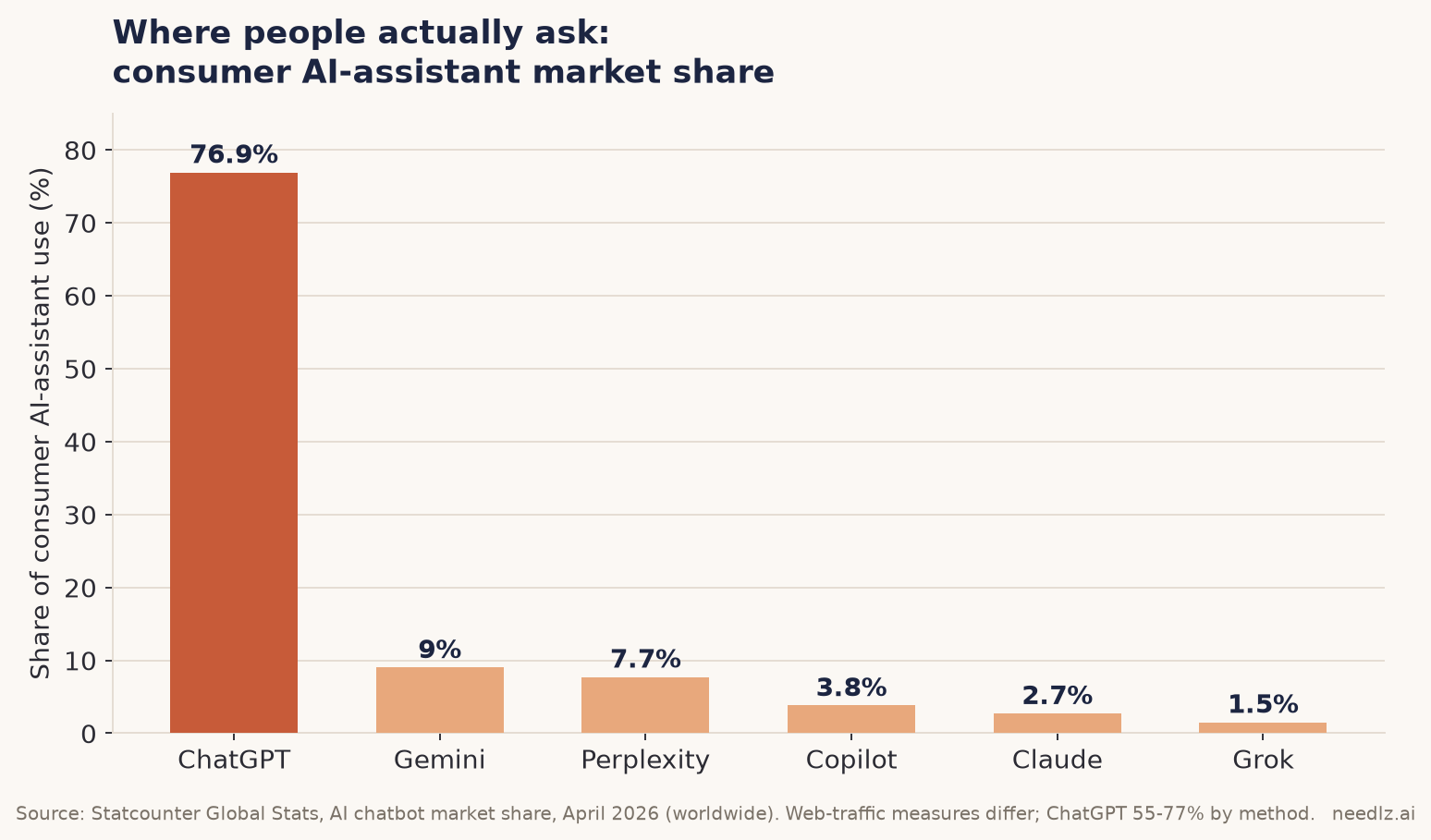
- ChatGPT dominates consumer use (
55–77% depending on the measure), with **900M weekly active users**. - Google Gemini is surging (it passed ~900M monthly active users), benefiting from Search and Android distribution.
- Meta AI reports ~1B monthly users across Meta's apps; Microsoft Copilot ~420M.
- Perplexity and Grok are smaller but meaningful, especially for research and social-flavored queries.
That's the universe of "where a person types a buying question." It is small, Western, and concentrated.
Where builders build (a different world)
Now the twist that surprises people — and it surprised us in the best way:
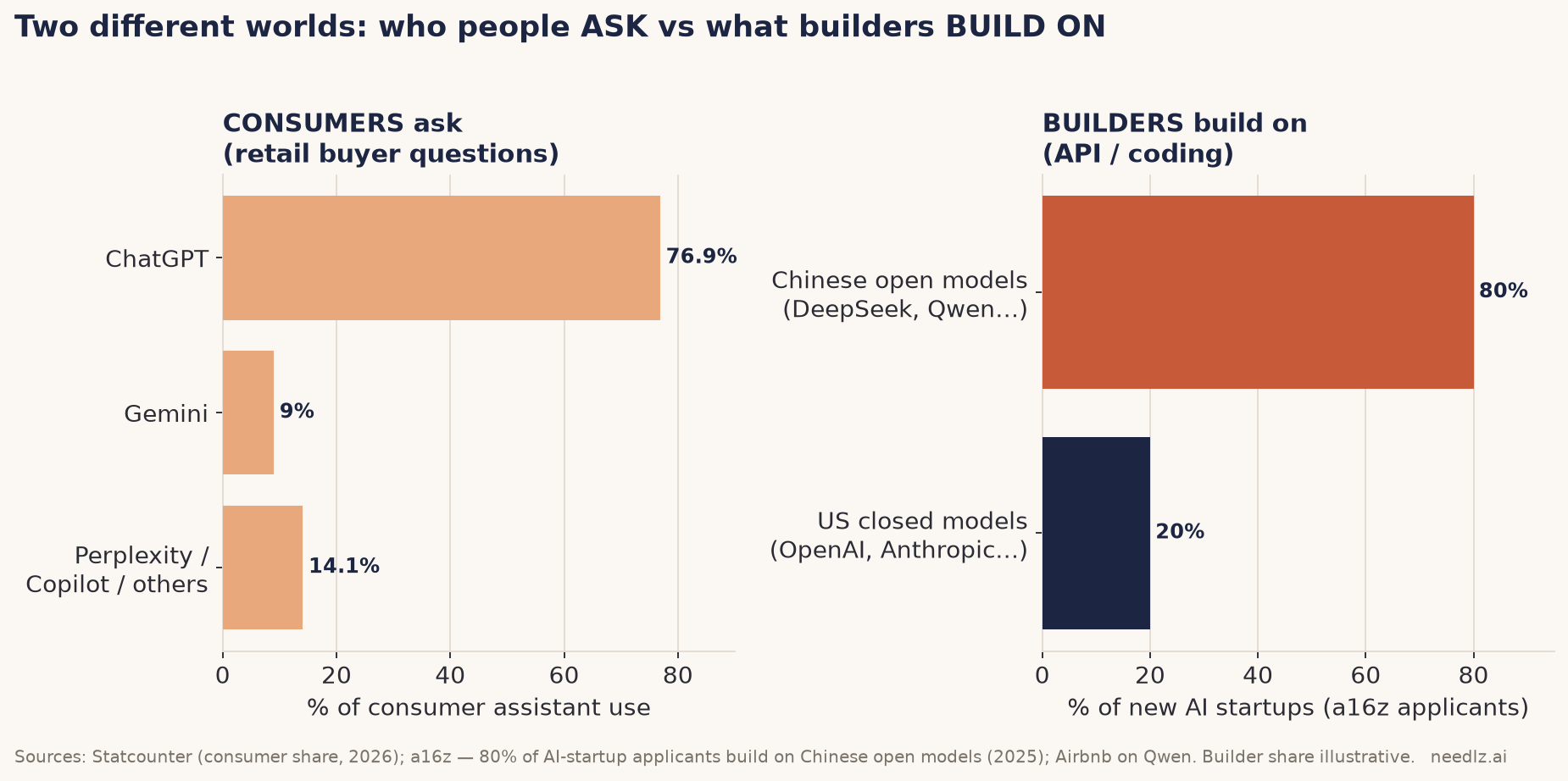
The cheaper, often Chinese, open models dominate a completely different arena — developers building software:
- By 2025, ~80% of AI startups applying to a16z were building on Chinese open-source models (DeepSeek, Qwen, etc.).
- Airbnb's CEO said the company "heavily relies on Alibaba's Qwen," while OpenAI models were "not used much in production."
- DeepSeek is 35–100× cheaper per token than US frontier models — the same coding workload can cost $252/month on DeepSeek vs $22,500 on a US frontier model.
But this is API and coding usage — the engine inside other people's apps. It is not where a retail buyer asks "what's the best CRM for my startup?" Consumers don't open DeepSeek to comparison-shop; they ask ChatGPT, Gemini or Copilot.
Why this comforts our strategy
This split is exactly why needlz focuses its coverage on the three engines buyers actually use — Google AI Overviews, ChatGPT and Gemini: that's where retail/buyer questions are asked. Chasing citations inside developer-only models would be optimizing for where code runs, not where customers decide. We tap the engines people ask — not the engines builders build on. (There's a real, separate opportunity in Chinese consumer assistants for brands selling into China — but that's a distinct market with a distinct source ecosystem; see GEO by Language & Country.)
The takeaways
- For getting cited where buyers look: the consumer assistants are the whole game, and they're concentrated — you can realistically cover them.
- Don't be distracted by the "DeepSeek is winning" headlines — that's the builder world, not the buyer world.
- Watch the shift: Gemini's surge and Meta AI's billion users mean the consumer set is moving — which is why per-engine, continuous measurement matters. (See The Moving Target.)
For the full per-engine citation breakdown, read the pillar: The Citation Economy.
needlz.ai helps brands earn citations in the AI answers buyers actually ask — and proves the lift. Earned, never rented.