
Generative Engine Optimization (GEO)
A economia da citação: um guia de campo do Generative Engine Optimization (GEO)
A versão curta. Por vinte e cinco anos, ser encontrado na internet significava posicionar — subir numa lista de dez links azuis que dava para trabalhar com conteúdo e orçamento suficientes. As respostas de IA mataram a lista. Agora existe uma resposta sintetizada e um punhado de fontes em que ela escolheu confiar, e a única pergunta que importa é: a resposta citou você? Isso não é uma mudança de ferramenta. É uma mudança na unidade de visibilidade — do link posicionado para a citação conquistada — e ela recompensa comportamentos completamente diferentes. Não dá para comprar uma citação. Não dá para forjar citações em escala. Você conquista sendo a fonte genuinamente mais útil nos lugares em que um modelo já confia. A visibilidade está virando conquistada, não alugada — e, pela primeira vez, mensurável.
As principais constatações deste guia
- O volume de busca tradicional deve cair 25% até 2026 à medida que os compradores migram para assistentes de IA (Gartner).
- 58,5% das buscas nos EUA e 59,7% das buscas na UE já terminam sem clique — chegando a ~83% quando aparece um AI Overview.
- O mercado de GEO deve crescer de ~$1.0–1.5B em 2026 para ~$17B até 2034 (≈40–50% de CAGR).
- Os motores mal concordam: apenas ~11% dos domínios citados coincidem entre ChatGPT e Perplexity.
- Popularidade não conquista citações: número de inscritos e de visualizações no YouTube mostra correlação praticamente zero com ser citado; 41% dos vídeos citados por IA têm menos de 1.000 visualizações.
- Google e OpenAI pagam ao Reddit, somados, ~$130M por ano para licenciar o conteúdo de comunidade em que as respostas deles se apoiam.
Parte I — A virada
O que é Generative Engine Optimization (GEO)?
Generative Engine Optimization é a prática de conquistar para a sua marca um lugar dentro das respostas geradas por IA — ser compreendido, considerado confiável, resumido, recomendado e citado por sistemas como os AI Overviews do Google, o ChatGPT, o Perplexity, o Gemini e o Claude.
O SEO tradicional responde à pergunta "como posicionamos esta página?". O GEO responde a uma mais difícil: "como viramos uma fonte a partir da qual a resposta é construída?". Um resultado de busca entrega ao usuário uma lista para avaliar. Uma resposta generativa entrega uma conclusão — e uma lista curta de citações. GEO é a disciplina de entrar nessa lista curta.
Você verá o campo chamado de várias formas. São primos, não sinônimos:
| Termo | O que enfatiza |
|---|---|
| GEO — Generative Engine Optimization | O mais amplo: conteúdo + autoridade + sinais de entidade que fazem você ser citado e recomendado nos motores generativos. O termo com mais tração. |
| AEO — Answer Engine Optimization | Mais estreito: estruturar conteúdo para ser devolvido como resposta direta (linhagem dos featured snippets). |
| LLMO / AI SEO | Rótulos guarda-chuva para "otimizar para grandes modelos de linguagem / busca por IA". |
Ao longo deste guia usamos GEO como termo guarda-chuva.
Qual é o tamanho do mercado de GEO hoje?
Grande o bastante para os analistas já estarem precificando. As estimativas para 2026 se concentram em torno de $1.0–1.5 bilhão, com projeções chegando a ~$17 bilhões até 2034, a uma taxa composta de crescimento de aproximadamente 40 a 50% ao ano (IntelMarketResearch, MarketIntelo, OpenPR). Os motores que esses orçamentos perseguem já processam, segundo estimativas, mais de 15 bilhões de consultas de IA por mês.
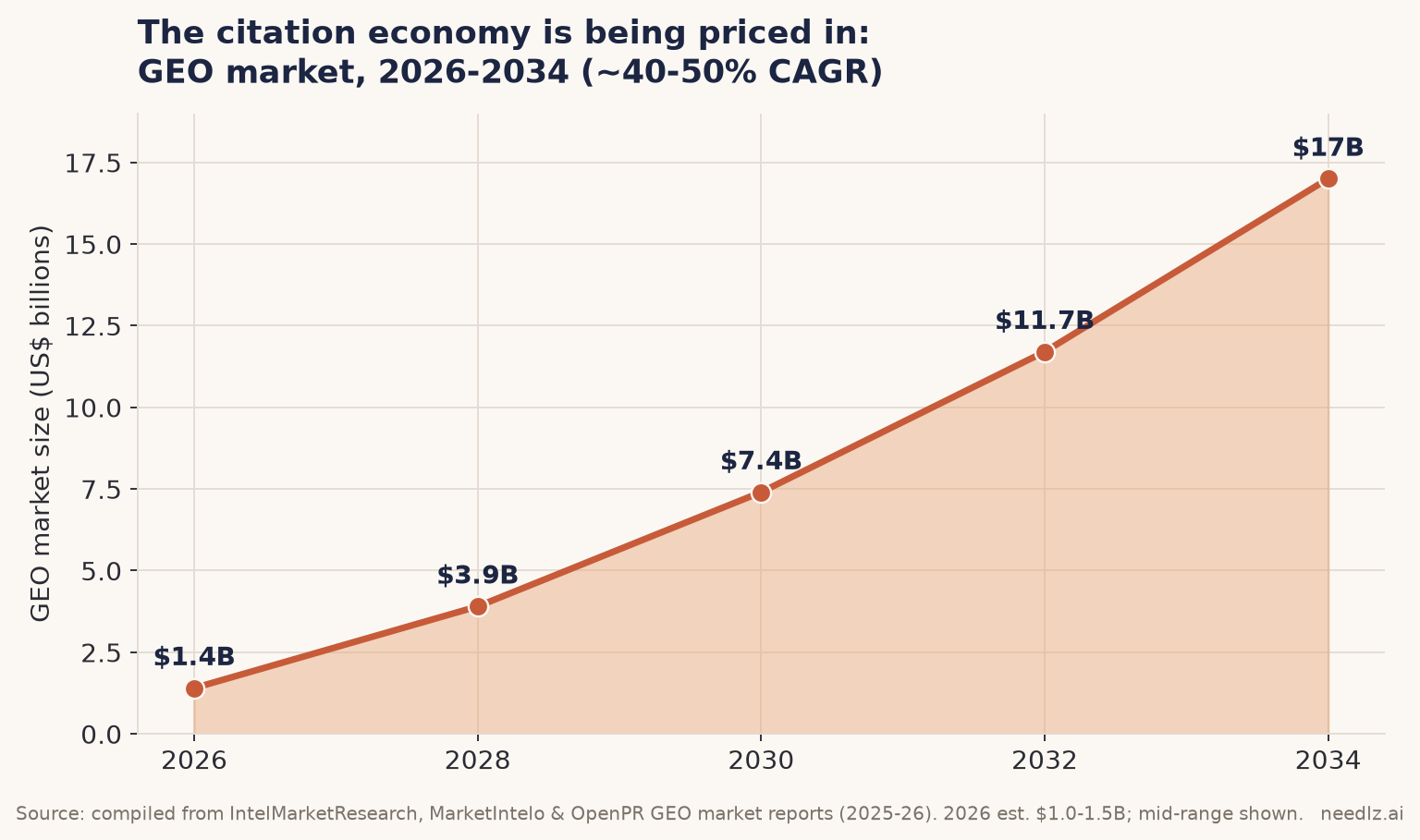
A nossa leitura: os valores são novos e as metodologias discordam — trate os números absolutos como direcionais. A direção, no entanto, não está em dúvida. O dinheiro segue a atenção, e a atenção se mudou para a caixa de resposta.
As pessoas estão mesmo migrando da busca para a IA?
Estão — e mais rápido do que a versão confortável desta história admite.
- O Gartner prevê uma queda de 25% no volume de busca tradicional até 2026, à medida que os usuários migram para chatbots e agentes virtuais. Como disse Alan Antin, VP Analyst do Gartner, a IA generativa está virando um "motor de resposta substituto".
- O tráfego de referência vindo de IA para sites de varejo dos EUA cresceu 693% em um ano durante a temporada de fim de ano de 2025.
Devemos a você o contra-argumento, porque rigor é mostrá-lo: o Search Engine Journal publicou um caso bem argumentado sobre por que o número de 25% pode estar superestimado, e o volume de busca em termos absolutos ainda é enorme. As duas coisas são verdade. A busca não está sumindo — mas o papel dela está mudando de destino para ingrediente, e o clique que ela mandava é o que está desaparecendo.
O que é busca sem clique — e a "economia da citação"?
Uma busca sem clique é aquela que termina sem o usuário entrar em nenhum site — porque a resposta foi entregue ali mesmo. Já não é exceção:
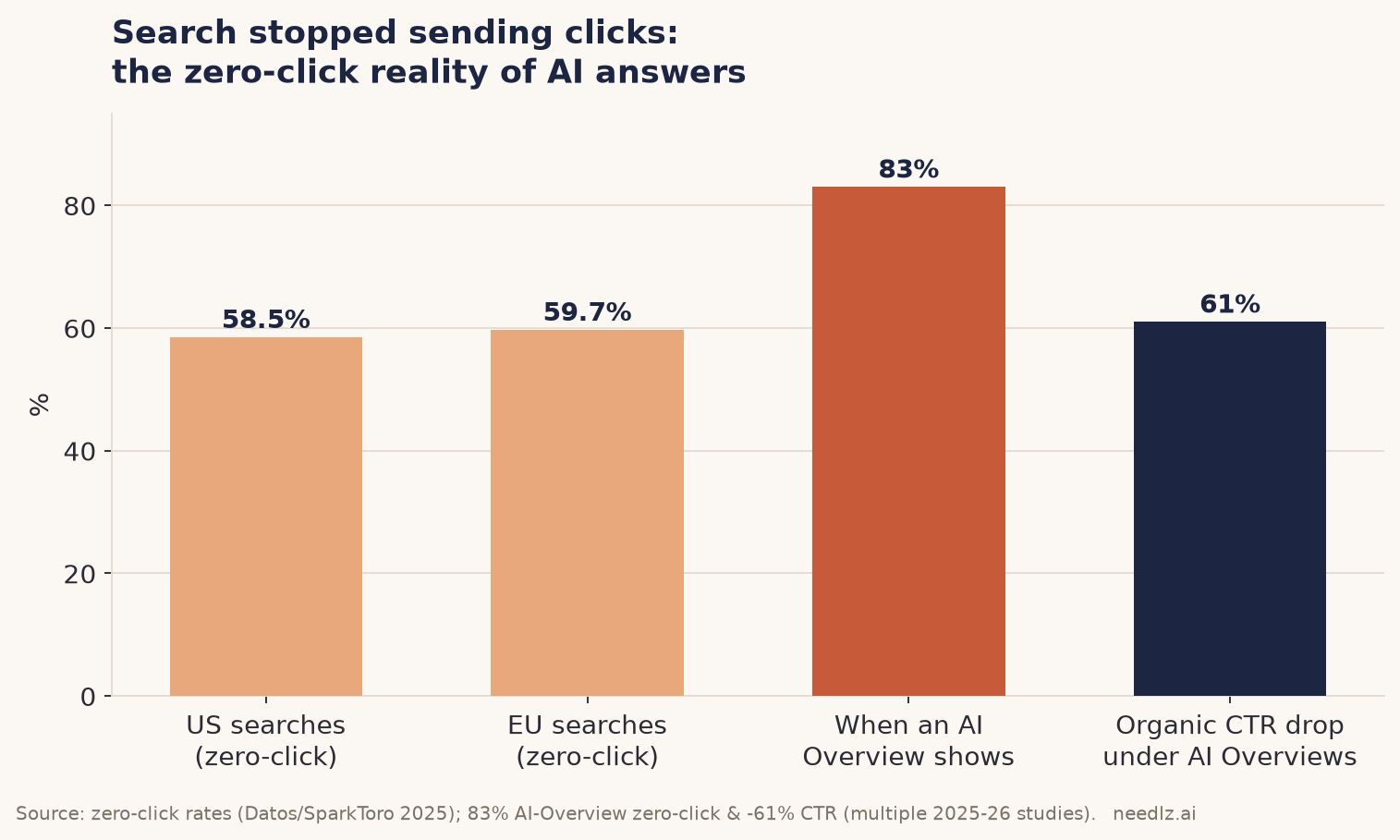
- 58,5% das buscas nos EUA e 59,7% das buscas na UE terminam sem clique (Datos / SparkToro, 2025).
- Quando aparece um AI Overview, o zero-clique sobe para ~83%, e as taxas de clique orgânico caem até 61% nessas consultas.
Aqui está a consequência incômoda, dita sem rodeios: se a sua estratégia está construída sobre o clique, ela está construída sobre um ativo que encolhe. A métrica que sobrevive não é tráfego — é presença: a sua fatia das próprias respostas. Chamamos o mundo que isso cria de economia da citação — em que a visibilidade é distribuída não por quem se posiciona, mas por quem é citado.
Parte II — Como funciona (a caixa-preta)
GEO ou SEO: o que muda de verdade?
Eles se sobrepõem, mas otimizam para linhas de chegada diferentes.
| SEO | GEO | |
|---|---|---|
| Objetivo | Posicionar uma página na lista de resultados | Virar uma fonte dentro da resposta |
| Unidade de valor | O link posicionado | A citação conquistada |
| Métrica de sucesso | Posição, cliques, tráfego | Presença, participação de voz em citações |
| Alavanca principal | Palavras-chave, backlinks, saúde técnica | Clareza, autoridade, corroboração entre fontes |
| Onde o trabalho acontece | Principalmente no seu próprio site | O seu site + as fontes de terceiros em que a IA confia |
| Tempo até o feedback | Monitores de posição, diário | Indireto, mais lento, multimotor |
| Dá para comprar a entrada? | Em parte (anúncios, link building) | Não — se conquista |
A conclusão honesta não é "SEO ou GEO". É SEO mais GEO: as páginas que se posicionam costumam ser as páginas que a IA lê, então a fundação ainda importa — mas posicionar já não é a linha de chegada.
GEO é uma caixa-preta? E como se mede isso?
Em boa parte, sim — e fingir o contrário é como as agências vendem demais. Não existe "monitor de posição" para respostas de IA. Os motores não publicam como escolhem as fontes, as respostas são personalizadas e não determinísticas (faça a mesma pergunta duas vezes e as citações podem diferir), e mudam de semana para semana. A medição é, portanto, indireta: você amostra respostas para um conjunto fixo de perguntas de compradores, em cadência, e acompanha padrões ao longo do tempo.
O conjunto de indicadores que substitui as posições:
- Participação de voz em citações — com que frequência você aparece frente aos concorrentes nas suas perguntas-alvo.
- Cobertura de prompts — quantas perguntas prioritárias fazem você aparecer, nem que seja uma vez.
- Mistura de fontes/canais — quais páginas constroem a resposta.
- Ganho de citações — a mudança antes e depois da sua atuação.
- Sentimento e exatidão — não só se você é citado, mas como você é descrito.
A opacidade é real. A resposta não é adivinhar — é medir continuamente e comprovar o movimento, a única forma honesta de operar dentro de uma caixa-preta.
Cada LLM tem o seu próprio "molho secreto"?
Enfaticamente sim. O fato mais importante — e menos compreendido — do GEO é que não existe "a IA". Existem IAs, e elas discordam. Uma síntese de grandes estudos de citação encontrou que apenas ~11% dos domínios citados coincidem entre ChatGPT e Perplexity. Uma marca "vencendo a busca por IA" é um erro de categoria: você vence um motor, para um tipo de consulta.
O Reddit é a ilustração mais clara. A mesma comunidade aparece de formas bem diferentes dependendo de quem responde:
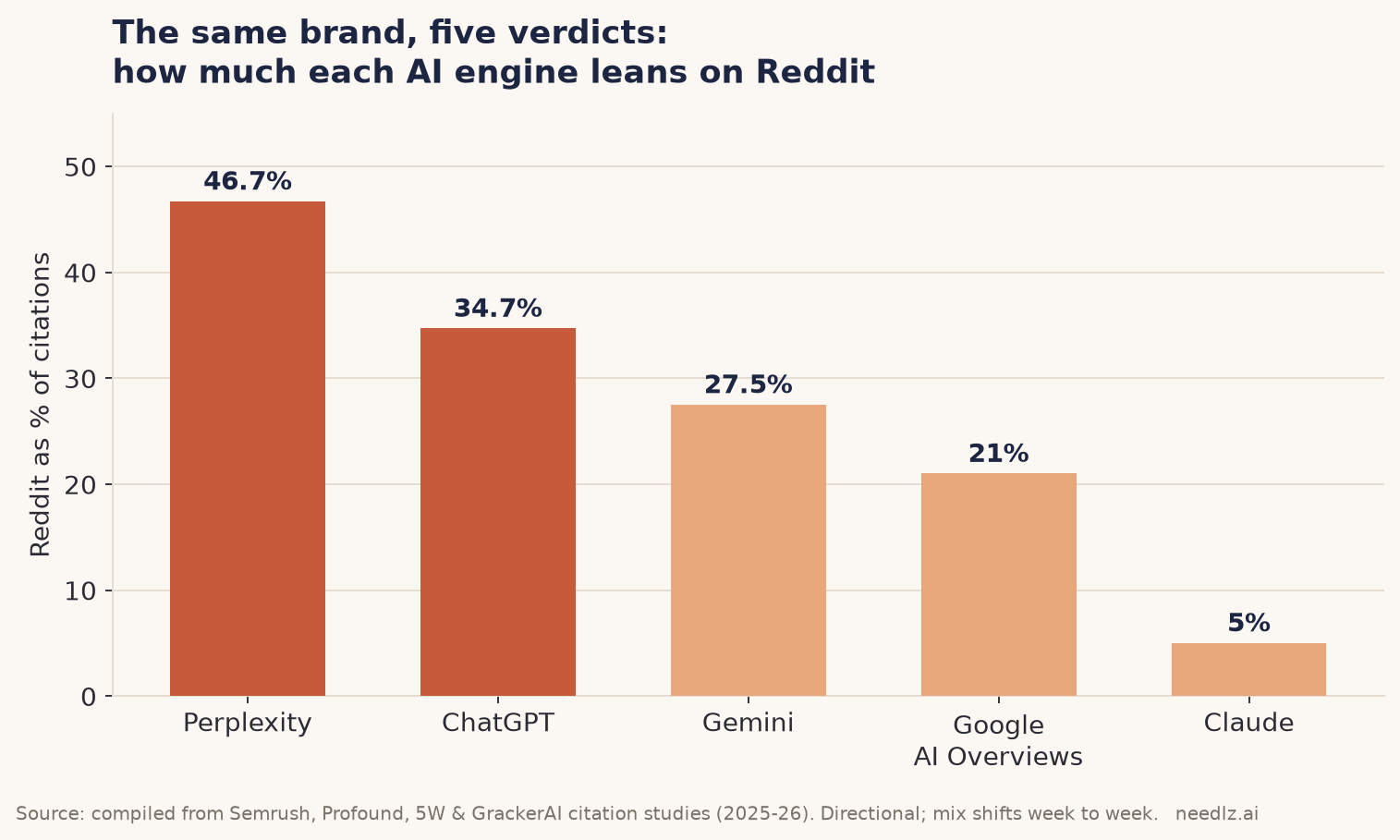
Cada motor tem uma impressão digital reconhecível (compilada de estudos da Semrush, Profound, 5W, GrackerAI e do blogdumodérateur, 2025–26; direcional e em movimento):
| Motor | Impressão digital de citações |
|---|---|
| Perplexity | Muito Reddit (~47%), LinkedIn e G2 para B2B, forte viés para conteúdo recente (<30 dias) |
| ChatGPT | Wikipédia dominante ( |
| Google Gemini | Reddit ( |
| Google AI Overviews | Puxado por comunidades: Reddit ( |
| Microsoft Copilot | Puxado por comércio: Amazon ( |
| Grok | Privilegia redes sociais — desproporcionalmente X e Reddit |
| Claude | Editorial estruturado, textos longos do LinkedIn, documentação com autoridade |
A implicação estratégica: "ser citado pela IA" não é um trabalho só. Para vencer Perplexity e Google, você trabalha comunidades (Reddit/Quora/YouTube). Para vencer ChatGPT, Gemini e Claude, você também precisa de Wikipédia, mídia, sites de avaliação e conteúdo próprio bem estruturado. Quem mede por motor vence.
Como a IA de fato escolhe o que citar?
Não por popularidade. Essa é a descoberta mais contraintuitiva — e mais libertadora — do campo.
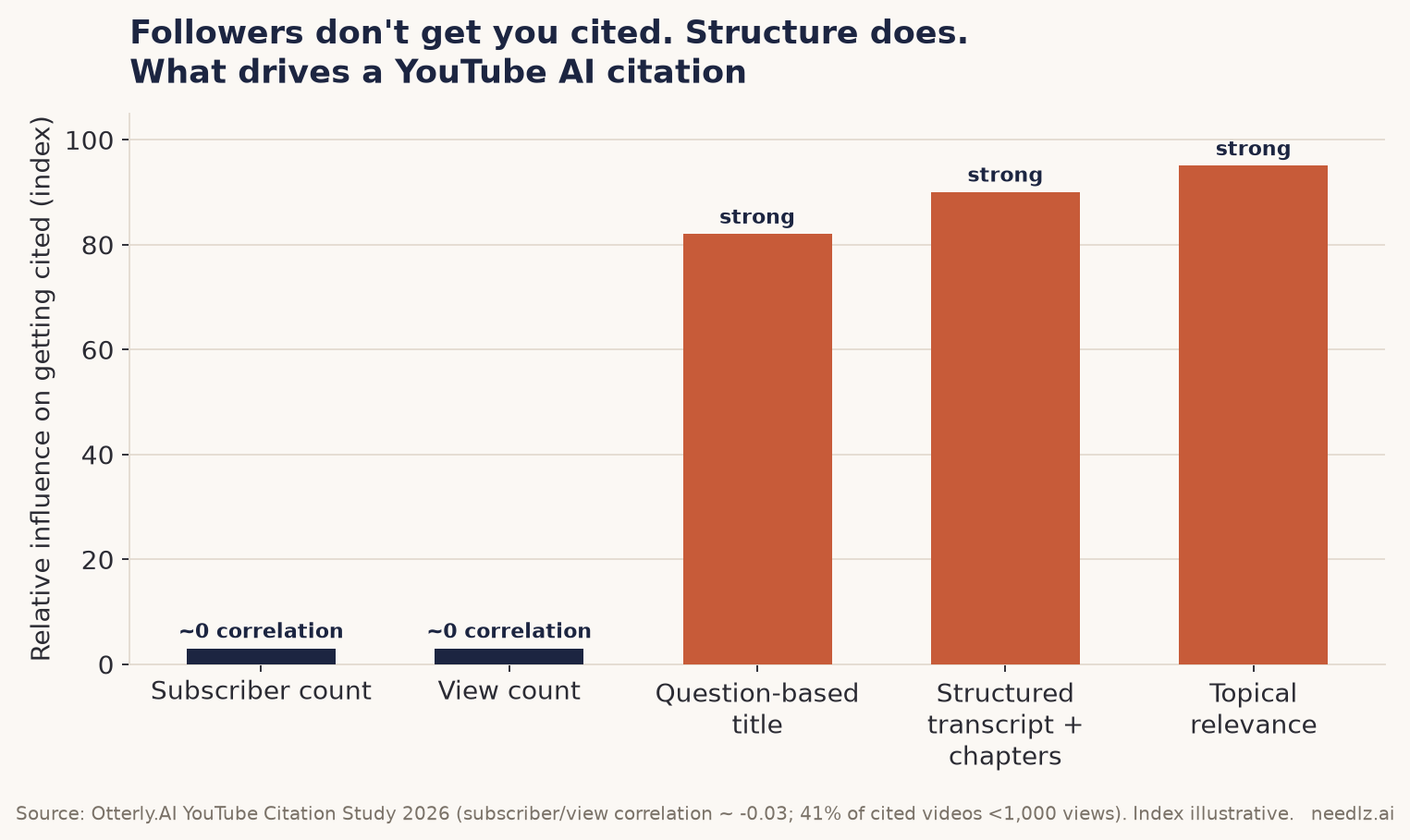
O Estudo de Citações no YouTube da Otterly.AI (2026) encontrou que número de inscritos e de visualizações tem correlação quase zero com ser citado (Pearson ≈ −0,03), e que 41% dos vídeos citados por IA tinham menos de 1.000 visualizações. O que de fato leva a citações: um título em forma de pergunta, uma transcrição limpa com marcações de tempo e uma descrição estruturada de mais de 500 palavras, e relevância temática. A IA trata o YouTube como uma biblioteca de referência, não como um concurso de popularidade — o que significa que um canal novinho, sem seguidores, pode ser citado se o conteúdo responder claramente à pergunta.
A mesma lógica se generaliza. Os motores recompensam clareza, especificidade, corroboração e confiança — uma resposta factual direta em um lugar confiável — em vez de alcance ou discurso de venda. Um tom de venda atrapalha de verdade.
Quais fontes são mais citadas?
Nas superfícies de IA do Google, as comunidades dominam a mistura de citações:
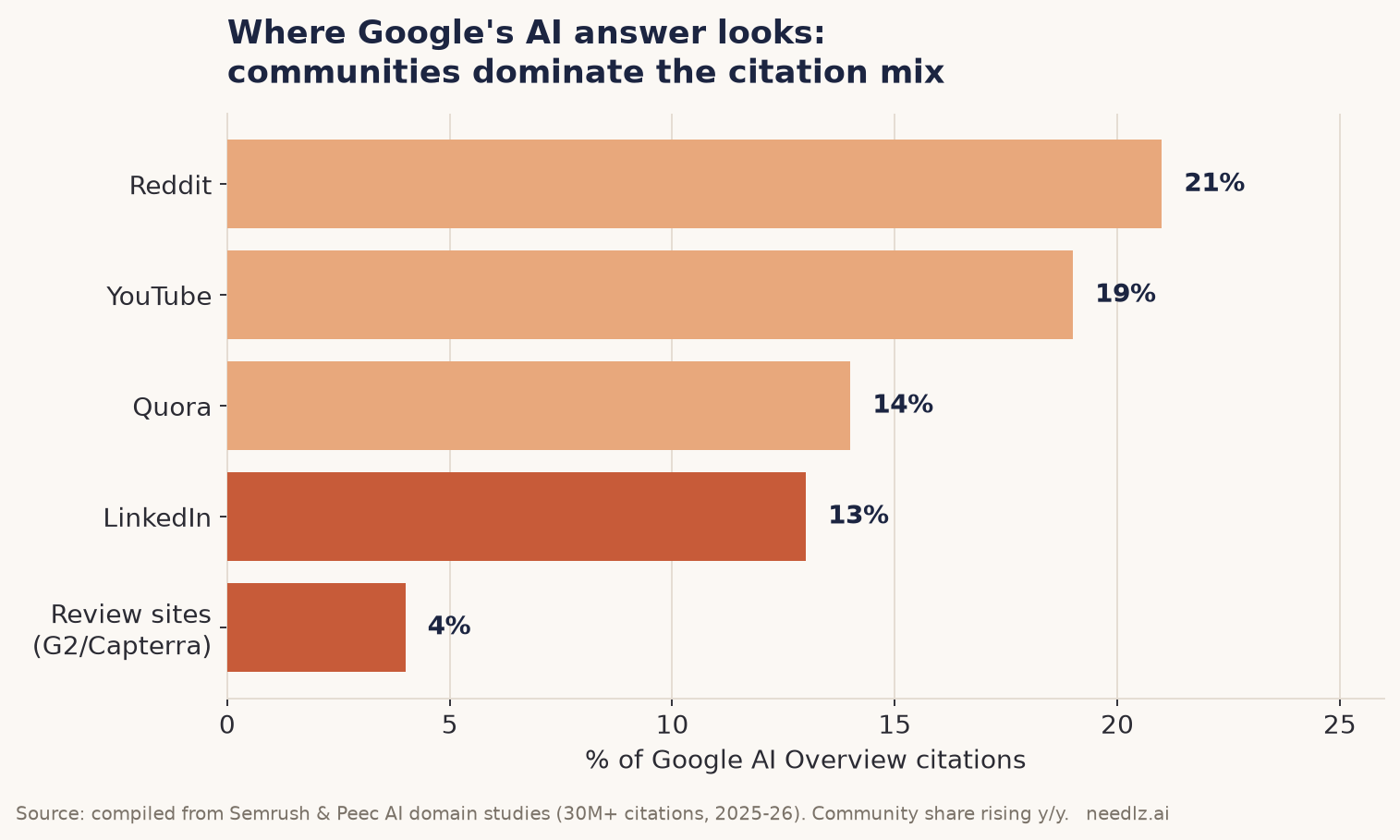
E as plataformas estão colocando dinheiro nisso: o Google pagaria ao Reddit cerca de ~$60M por ano e a OpenAI ~$70M por ano para licenciar conteúdo de comunidade para os produtos de IA deles. Quando uma plataforma paga nove dígitos por uma fonte, ela está dizendo de onde virão as respostas.
As citações variam conforme a intenção do comprador?
Muito. Testamos isso diretamente. As consultas comerciais de "melhor X / qual ferramenta" são vencidas por listas, mídia de avaliação e conteúdo de comparação próprio — o Reddit mal aparece. As consultas de experiência — "o que as pessoas usam de verdade", "vale a pena", "alguém já tentou" — são onde as comunidades dominam.
| Tipo de consulta | Exemplo | O que ganha a citação |
|---|---|---|
| Comercial / comparação | "melhor CRM para startups" | Listas de "melhor X", G2/Capterra, páginas de comparação próprias |
| Experiência / opinião | "que CRM vocês usam de verdade?" | Reddit, Quora, tópicos de comunidade |
| Como fazer / educativo | "como eu configuro X?" | YouTube, documentação, guias estruturados |
| Marca / reputação | "a [marca] é boa?" | Avaliações, Reddit, as suas próprias provas |
A lição: case a superfície com a pergunta. Tratar toda consulta do mesmo jeito é por que tanto esforço de "visibilidade em IA" erra o alvo.
Parte III — O impacto
O SEO está morrendo?
Não — mas a versão confortável do SEO está. A leitura honesta das evidências:
- Os orçamentos de SEO continuaram crescendo em 2025–26, em parte por causa da virada da IA — quando os LLMs montam respostas a partir de páginas que já se posicionam, posicionar ainda importa como matéria-prima.
- E, ainda assim, 65% das buscas hoje terminam sem clique, e as métricas de que os SEOs viviam (posição, CTR, sessões) descrevem uma fatia cada vez menor da realidade.
Rand Fishkin: "A IA não está matando a busca." Ele também prevê que os usuários vão consumir 10× mais conteúdo por resumos de IA do que por artigos de verdade até o fim de 2026.
As duas coisas podem ser verdade. A disciplina não está morrendo; está se dividindo — na fundação técnica (ainda SEO) e na disputa pela resposta (agora GEO). Os profissionais em risco são os que ainda otimizam só para uma linha de chegada que cada vez menos usuários alcançam.
Se as respostas de IA reduzem a descoberta, o que acontece com o tráfego?
Ele comprime — e muda de forma. O clique pode cair ~61% nas consultas em que aparece um AI Overview, mesmo quando você ainda "se posiciona". Mas um canal novo cresce no lugar: o tráfego de referência vindo de IA (visitas de dentro do ChatGPT, do Perplexity etc.), que subiu 693% em um ano no período de fim de ano de 2025. O tráfego que resta é menor, mas de intenção mais alta — já foi pré-qualificado pela resposta. A resposta estratégica é parar de otimizar para volume e começar a otimizar para ser a fonte citada que conquista o clique de alta intenção.
Como profissionais e agências de SEO estão se adaptando?
O campo está se bifurcando entre quem adicionou GEO e quem não sobreviveu à transição. Agências estão se reembalando em torno de visibilidade em IA, monitoramento de citações e auditorias de "prontidão para resposta"; times internos estão adicionando mapas de prompts ao lado dos mapas de palavras-chave e participação de voz ao lado das posições.
Rand Fishkin, sobre terceirizar ou não: "Fazer por conta funciona se você tem tempo e conhecimento. Agências funcionam se falta um dos dois."
Os praticantes críveis (o trabalho da Seer Interactive "para além do hype de SEO contra GEO" é um bom exemplo) estão convergindo para um meio-termo sóbrio: GEO não é um substituto mágico, é uma extensão — os mesmos fundamentos de conteúdo útil e confiável, aplicados a uma nova linha de chegada.
O que acontece com idioma e geolocalização?
Esta é a fronteira mais subestimada — e ela quebra a "média global". A análise da Profound sobre 3,25 bilhões de citações em 7 modelos e 14 países encontrou que o idioma da consulta pesa mais que o país, e que o efeito varia muito conforme o modelo. Isso vale para perguntas informacionais: mude para intenção local e a geografia assume de novo, e a Profound emparelhou cada país com seu idioma nativo — um sinal direcional forte, não um experimento controlado. (Tratamento completo: GEO por idioma e país.)
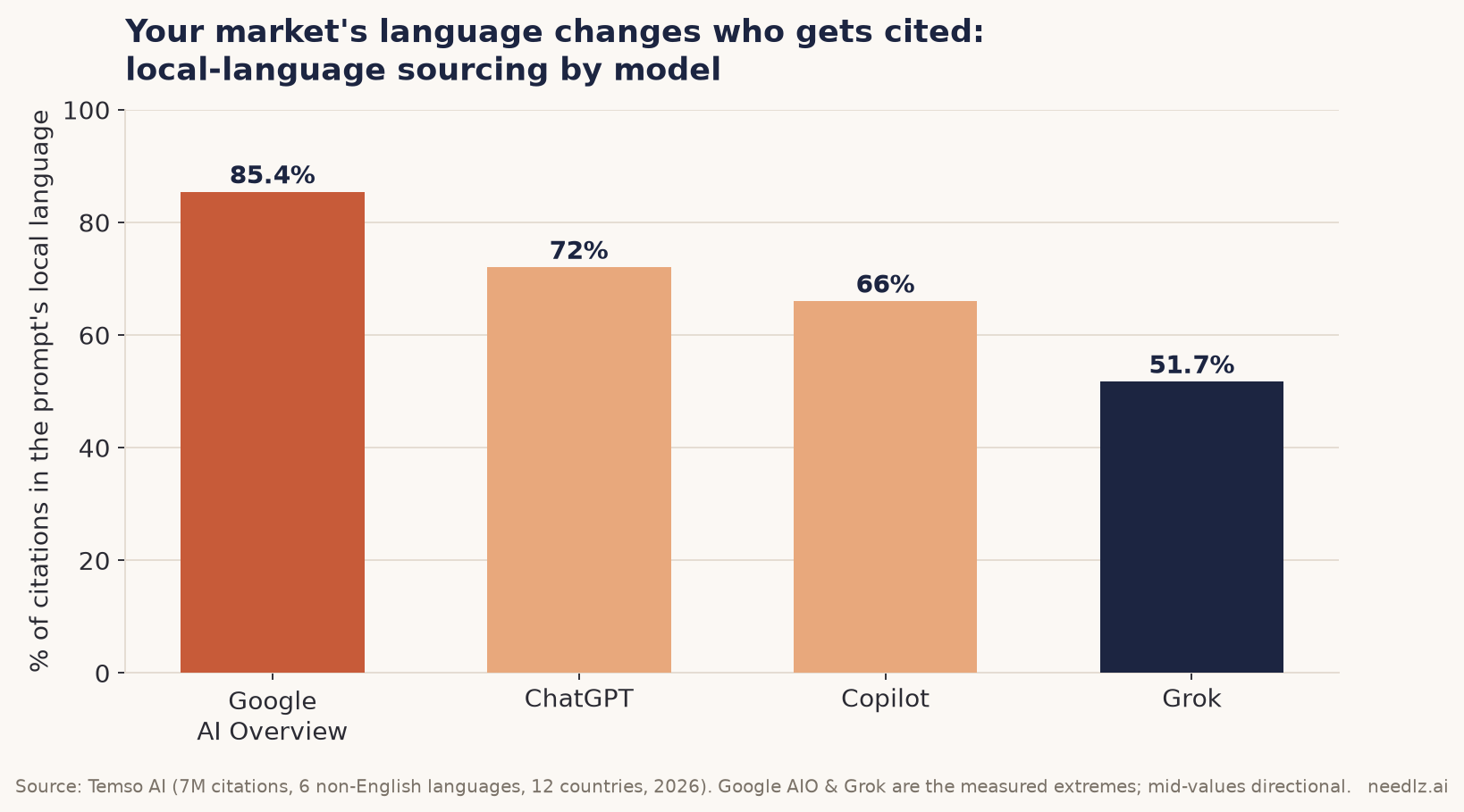
O estudo da Temso AI com 7 milhões de citações em seis idiomas fora do inglês e 12 países encontrou uma diferença de 34 pontos percentuais entre o modelo mais localizado (Google AI Overview, 85,4% de fontes no idioma local) e o menos localizado (Grok, 51,7%). E, no Oriente, o quadro muda por completo: os motores chineses (DeepSeek, Qwen, Baidu ERNIE) bebem de um ecossistema separado de fontes em chinês, em boa parte isolado da web ocidental.
O que levar daqui: não existe uma única "visibilidade em IA" para uma marca multimercado. Estratégia e medição de citações precisam considerar idioma e país, não uma média global.
O que o GEO significa para comércio, serviços e produtos?
A nossa opinião, por setor:
- E-commerce e produtos: a página do produto já não é o destino — a resposta é. Com o Copilot já citando bastante Amazon e Walmart e com as respostas de "compras" por IA crescendo, vencer significa presença em avaliações, especificações estruturadas e discussão autêntica do produto em comunidades — não só uma página de produto bonita.
- SaaS B2B: o setor com mais alavancagem em GEO, porque os compradores pesquisam exatamente nas superfícies que a IA cita (Reddit, G2, LinkedIn). A resposta de "melhor X" é o novo campo de batalha da geração de demanda.
- Local e serviços: o mais defensável, porque intenção local + avaliações + perguntas e respostas são difíceis de forjar e muito citados — mas exige um trabalho disciplinado de avaliações e reputação.
O fio condutor: a IA comprime a jornada de compra dentro da resposta. Quem está dentro dessa resposta captura a consideração antes de o site de um concorrente sequer ser aberto.
Parte IV — O playbook e a prova
Como se faz para ser citado?
Um playbook condensado e honesto:
- Mapeie prompts, não só palavras-chave. Comece pelas perguntas reais que os compradores fazem, ao longo do funil.
- Seja a melhor resposta de verdade onde os compradores já estão — Reddit, Quora e X para perguntas de experiência; de forma declarada, útil e sem venda. (Isto é participação, e é onde o esforço escala.)
- Dê ao seu conteúdo próprio o "formato de resposta": comece por uma resposta direta, acrescente evidências, estruture com títulos claros — para as consultas comerciais que as comunidades não vencem.
- Conquiste corroboração: dados de entidade consistentes, avaliações reais de clientes no G2/Capterra, menções críveis de terceiros.
- Publique onde isso conquista citações: um vídeo no YouTube com título em forma de pergunta e boa transcrição, ou um post substancial no LinkedIn — seguidores não são necessários.
- Trabalhe cada motor de forma deliberada — porque, como mostramos, eles recompensam coisas diferentes.
Como medir — e comprovar — que o GEO funciona?
Esta é a parte em que o setor é pior, e é a que mais importa. Prova não é "a gente postou". Prova é ganho de citações: a sua participação colocou você dentro da resposta?
- Estabeleça a linha de base da sua participação de voz em citações entre os motores antes de começar.
- Participe e então remeça em cadência (uma vez por semana já basta; as checagens são baratas e limitadas).
- Atribua com uma linha do tempo antes e depois por conquista e — o padrão-ouro — um grupo de controle: perguntas que você deliberadamente não trabalha, para que uma taxa de citação maior no grupo trabalhado seja evidência causal real, não correlação.
- Alerte no instante em que uma nova citação aparece.
As marcas que vencerem a economia da citação não serão as que gritarem mais alto. Serão as que conseguirem comprovar que conquistaram a resposta — e acumular em cima do que funcionou.
A ética do GEO: conquistado contra astroturfing
Há uma bifurcação nesta estrada, e ela importa. Um caminho é o disfarce — contas falsas, avaliações compradas, "slop" de IA em volume. Funciona até deixar de funcionar: as plataformas banem, os reguladores estão rondando a questão da transparência, e uma única reportagem pode incendiar uma marca. O outro caminho é o conquistado — participação declarada, humana, genuinamente útil. Achamos que o caminho conquistado não é apenas o ético; é o duradouro. Conquistado, nunca alugado.
Parte V — O futuro
O GEO vai substituir o SEO? O que vem depois?
As nossas previsões, para o registro:
- A "participação de voz em IA" vira uma métrica de conselho em ~3 anos — reportada ao lado de pipeline e reconhecimento de marca.
- Surge um cargo de "head de visibilidade em IA", dono do mapa de prompts como os líderes de SEO eram donos do mapa de palavras-chave.
- O orçamento migra de forma visível da compra pura de mídia e do link building para a conquista de citações.
- A medição se consolida como o primeiro gasto de verdade — não dá para gerenciar o que não se mede —, seguida pela camada de ação que efetivamente conquista citações.
- Os jogadores disfarçados se queimam. As normas de transparência e a fiscalização das plataformas endurecem; a visibilidade conquistada e comprovável vence no longo prazo.
O SEO não vai morrer. Ele vai virar a fundação sob uma disputa maior — a disputa por ser a resposta.
FAQ
O que é Generative Engine Optimization (GEO)? A prática de conquistar para a sua marca um lugar citado dentro das respostas geradas por IA (Google AI Overviews, ChatGPT, Perplexity, Gemini, Claude), em vez de apenas se posicionar na lista tradicional de resultados.
GEO é a mesma coisa que SEO? Não. O SEO otimiza para posicionar uma página; o GEO otimiza para virar uma fonte dentro da resposta. Eles se sobrepõem nos fundamentos, mas a linha de chegada é outra.
GEO é a mesma coisa que AEO? AEO (Answer Engine Optimization) é mais estreito — estruturar conteúdo para ser devolvido como resposta direta. GEO é a disciplina mais ampla, que inclui autoridade, entidades, corroboração externa e medição multimotor.
O SEO está morrendo? Não, mas está se dividindo. A fundação (saúde técnica, conteúdo útil) ainda importa; a linha de chegada está migrando de posicionar para ser citado.
Qual é o tamanho do mercado de GEO? Aproximadamente $1.0–1.5B em 2026, projetado para ~$17B até 2034 a ~40–50% de CAGR (direcional; as estimativas variam por fonte).
As pessoas estão mesmo migrando da busca para a IA? O Gartner prevê uma queda de 25% no volume de busca tradicional até 2026; as buscas sem clique já passam de 58% e chegam a ~83% quando aparece um AI Overview.
Por que a IA cita tanto o Reddit? A IA busca respostas autênticas, baseadas em experiência — e as plataformas pagam por isso (Google ~$60M/ano, OpenAI ~$70M/ano). O Reddit é a fonte nº 1 em vários motores, mas a fatia dele varia muito por motor e por tipo de consulta.
O ChatGPT cita o Reddit?
Cita (35% nos dados recentes), mas com menos consistência que o Perplexity (47%) e de forma mais volátil; o ChatGPT se apoia mais fortemente na Wikipédia.
Seguidores ou visualizações ajudam a ser citado no YouTube? Não — número de inscritos e de visualizações tem correlação quase zero com citações. Estrutura, qualidade da transcrição e relevância, sim. 41% dos vídeos citados por IA têm menos de 1.000 visualizações.
O GEO muda conforme idioma e país? Muito. O idioma da consulta pesa mais que a geografia, e os modelos localizam de formas bem diferentes (Google AIO ~85% no idioma local contra Grok ~52%). Isso vale para perguntas informacionais — a intenção local devolve o peso à localização. Os motores chineses usam um ecossistema de fontes separado.
Como eu meço o sucesso em GEO? Participação de voz em citações, cobertura de prompts, mistura de fontes/canais e ganho de citações (antes e depois, idealmente com um grupo de controle) — medidos continuamente, por motor.
Quanto tempo até ver resultados? Normalmente de 2 a 6 semanas para as primeiras citações depois de uma participação forte; movimento relevante de participação de voz ao longo de 1 a 3 meses. E acumula.
GEO não é só astroturfing? Não deveria ser. Táticas de disfarce (contas falsas, avaliações compradas) trazem risco de banimento, jurídico e de reputação. A abordagem duradoura é participação declarada, humana e genuinamente útil.
Metodologia e fontes
Como compilamos isto. Os números deste guia são sintetizados de estudos de citação e relatórios de mercado publicados por terceiros (2024–2026), somados ao framework próprio da needlz e a testes direcionais. Quando um número vem de um único estudo, nós o nomeamos. Quando os estudos discordam (por exemplo, tamanho do mercado de GEO, participação do Reddit por motor), apresentamos faixas e as rotulamos como direcionais. O comportamento de citação das IAs é não determinístico e muda de semana para semana; trate todos os percentuais como sinais de um momento, não como constantes. Um estudo da needlz Research ainda por vir publicará dados primários: um conjunto fixo de perguntas de compradores rodado nos principais motores, com metodologia completa e base de dados abertas para escrutínio.
Fontes. Gartner (previsão de volume de busca); Datos / SparkToro (zero-clique); Semrush, Ahrefs, Profound, Peec AI, 5W, GrackerAI, LLM Pulse (estudos de fontes citadas); Foundation (citações em SaaS B2B); Otterly.AI (estudo de citações no YouTube); Temso AI e Profound (estudos de citação por idioma e geografia); IntelMarketResearch, MarketIntelo, OpenPR (tamanho do mercado de GEO); Princeton/Georgia Tech (pesquisa de GEO); divulgações de licenciamento do Reddit (Google, OpenAI); Search Engine Journal (o argumento cético); Seer Interactive; comentários de Rand Fishkin e Lily Ray.
Este guia é atualizado conforme os dados se movem. Last updated: 21 de junho de 2026.
A needlz.ai ajuda marcas a conquistar citações nas respostas de IA — e comprova o ganho. Encontre a única conversa que vale responder hoje. Conquistado, nunca alugado.